
Monero vs Zcash, Dash and LTC MWEB — Why XMR
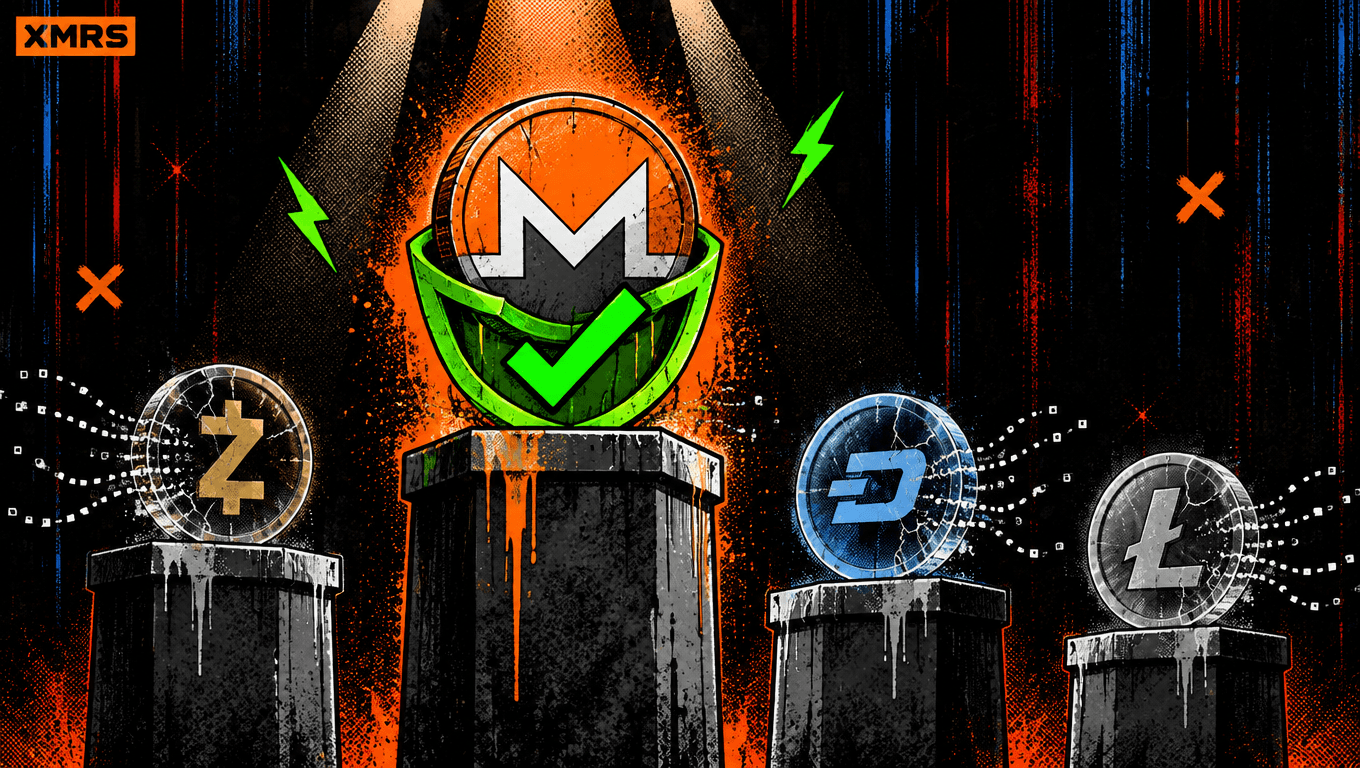
Several coins market themselves on privacy, and they are not equivalent. The single most important axis is whether privacy is default or optional — because optional privacy is, in practice, mostly unused privacy. Here is how the commonly swapped options actually compare, without the marketing gloss.
The one distinction that matters
A privacy feature only protects you if it is on. When privacy is optional, most transactions skip it, which shrinks the anonymity set for everyone and leaves the "private" version rarely used. When privacy is the default and mandatory, every transaction contributes to the crowd you hide in. That difference decides most of the comparison below.
Monero (XMR) — private by default
Monero shields the sender, receiver, and amount on every transaction automatically. There is no transparent mode to forget to turn off, and because privacy is mandatory, the anonymity set is the whole network. Ring signatures, stealth addresses, and confidential amounts are always in effect. The trade-offs are real but modest: larger transactions and the need to sync with a node (ideally your own, over Tor). For default, no-thought privacy, it is the baseline the others are measured against.
Zcash (ZEC) — strong crypto, optional use
Zcash's shielded pool uses well-regarded cryptography and can offer excellent privacy. The catch is that it is opt-in: transparent `t`-addresses behave like Bitcoin, most exchange flow is transparent, and moving between transparent and shielded can leak. The cryptography is not the weak point — human and ecosystem behavior is. If everyone shielded everything, Zcash would be formidable; in reality much of it stays public.
Dash (DASH) — transparent with a light mixer
Despite its reputation, Dash is transparent by default. PrivateSend is an optional CoinJoin-style mixer with a limited number of rounds and modest anonymity sets. It obfuscates; it does not approach Monero-grade privacy, and careless reuse undoes it easily. Dash's genuine strengths are speed and payments, not confidentiality.
Litecoin MWEB — a bolt-on, not a default
MWEB adds a confidential extension to Litecoin, which is a real improvement over plain LTC. But it is opt-in, wallet support is uneven, and ordinary Litecoin transactions remain fully transparent. As with Zcash and Dash, the privacy exists only if you deliberately use it and keep using it consistently.
Why XMR remains the baseline
The others are not worthless — Zcash's cryptography is serious, Dash is a capable payment coin, MWEB improves Litecoin. But if the goal is privacy you get without thinking about it, Monero is the one where "private" is simply how it works. That is why, across these options, XMR stays the reference point — and why a Monero hop is a common way to convert weaker or optional privacy into the default kind. Coming from any of them, you can move into it directly, for example via ZEC → XMR or DASH → XMR.




